Indiana Money Transmitter Bond Overview
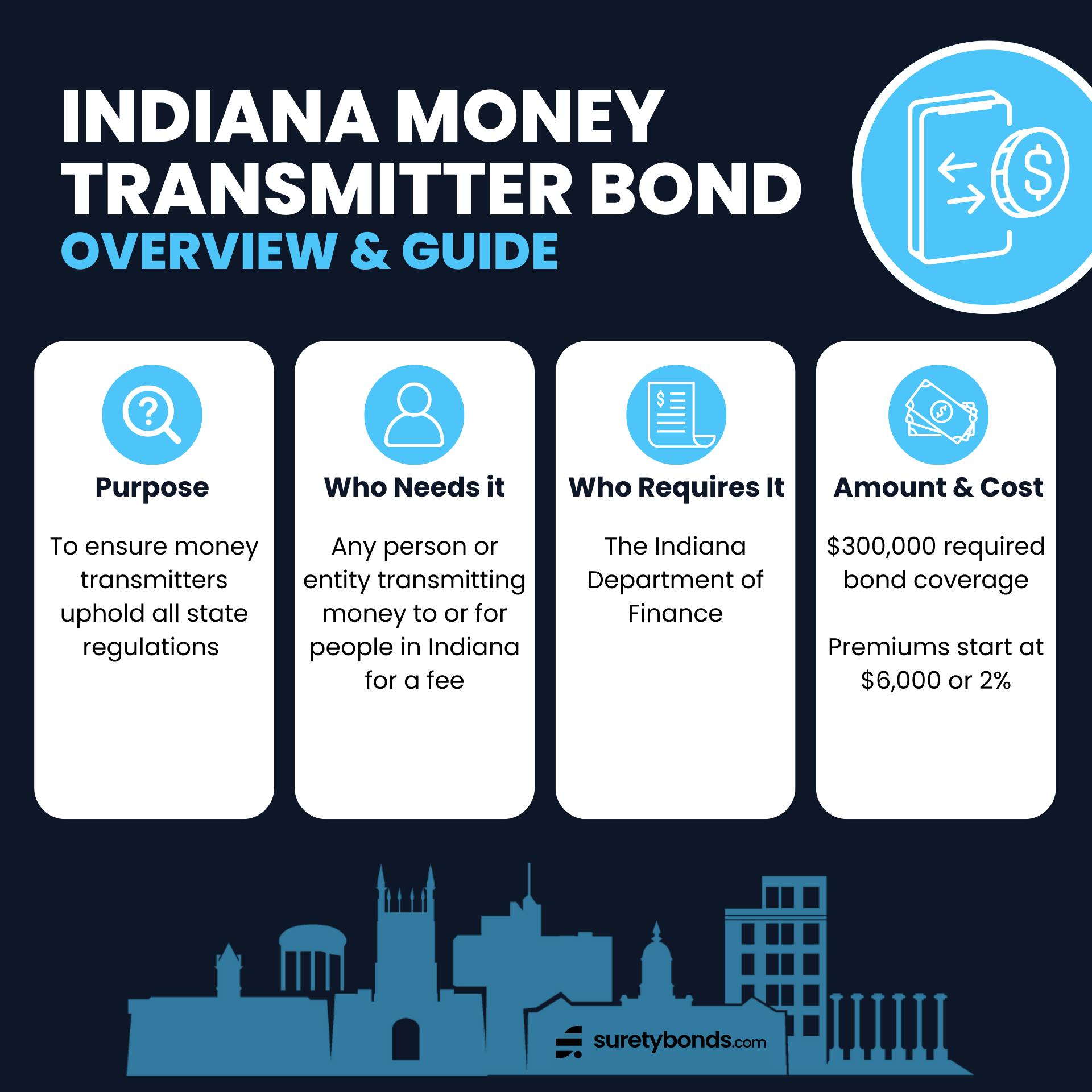
- Purpose: To ensure money transmitters uphold all state regulations
- Who Needs It: Any person or entity transmitting money to or for people in Indiana
- Regulating Body: The Indiana Department of Finance
- Bond Amount: $300,000
- Minimum Price: $6,000
What Is an Indiana Money Transmitter Bond?
An Indiana money transmitter bond is a financial guarantee required for businesses that sell payment instruments, offer prepaid access, or transfer money. It is similar to insurance, but protects consumers rather than the business.
The Indiana Department of Finance requires a $300,000 money transmitter bond to protect the public from fraudulent actions and non-compliant practices.
Who Needs a Money Transmitter Bond?
Under the 2024 Indiana Money Transmitter Modernization Act (MTMA), any entities performing money transmissions need to comply with standardized licensing requirements, including filing a $300,000 surety bond.
The state defines “money transmission” as any of the following activities:
- Selling or issuing payment instruments to a person located in Indiana
- Selling or issuing stored value to a person located in Indiana
- Receiving money for transmission from a person located in Indiana
Typically, this does not include virtual currency transmitters, payroll processors or bill pay service providers, but always verify with the state.
How Much Do Money Transmitter Bonds Cost in Indiana?
The $300,000 money transmitter bond premium starts at a 2% rate — or $6,000. Pricing is personalized based on credit score, apply now to get your free quote.
SuretyBonds.com offers the lowest available rates from our nationwide provider network with no added fees.
How Does an Indiana Money Transmitter Bond Work?
A money transmitter bond joins three parties into a legally and financially-binding contract.
| Bond Party | Description |
|---|---|
| 1) Principal | The money transmitter entity |
| 2) Obligee | The Indiana Department of Financial Institutions |
| 3) Surety | The issuing surety provider |
As the principal, you are responsible for upholding your obligation to the DFI (the obligee). That means following all licensing rules, regulations and laws.
If you fail to do so, harmed parties can file bond claims, which the surety reimburses. However, you will then need to repay the surety.
How Do I Get a Money Transmitter Bond in Indiana?
Start the bonding process by submitting a quote request form with SuretyBonds.com. We’ll provide a quote within one business day or less.
Review and pay your premium invoice online at your convenience. Once the transaction is processed, we’ll upload the bond to NMLS on your behalf.
However, you’ll need to grant authority to your issuing surety provider. When you log in to your NMLS account, enter the surety’s name or surety identifier (NAIC/NPN), which will be in your email records.
How Fast Can I Get My Bond?
You can get your money transmitter bond as quickly as same-day with SuretyBonds.com if you complete the application before about 1 pm CST Mon–Fri.
If you qualify for the minimum rate, we can typically send you a quote invoice within hours. If your credit is on the lower end, we’ll shop our markets to find the best rate. However, this may delay your quote delivery time to 1–2 business days.
How Do I File My Bond?
You don’t have to file your Indiana money transmitter bond. We’ll upload the electronic surety bond directly to NMLS on your behalf!
How Do I Renew My Money Transmitter Bond?
To renew your bond each year, just pay your renewal premium invoice when prompted. If you work with us, we’ll start notifying you 90 days prior to the expiration date to ensure you don’t have a lapse in coverage.
No additional documentation is needed, unless you need to make a change to the bond.
How Do I Update My Bond Information?
If minor information has changed for your bond — such as address or name — we can likely issue a bond rider. This is a document that “rides” on top of your existing bond to amend the original information.
Please email the information you need updated to [email protected] for assistance.
How to Get a Money Transmitter License in Indiana
You’ll complete your license application through the Nationwide Multistate Licensing System (NMLS). Follow these steps:
- Register to do business with the Secretary of State
- Meet compliance requirements under the MTMA
- Purchase a surety bond
- Apply through NMLS
- Submit all documents and fee payments
If you have licensing questions, you can reach the DFI staff at [email protected].