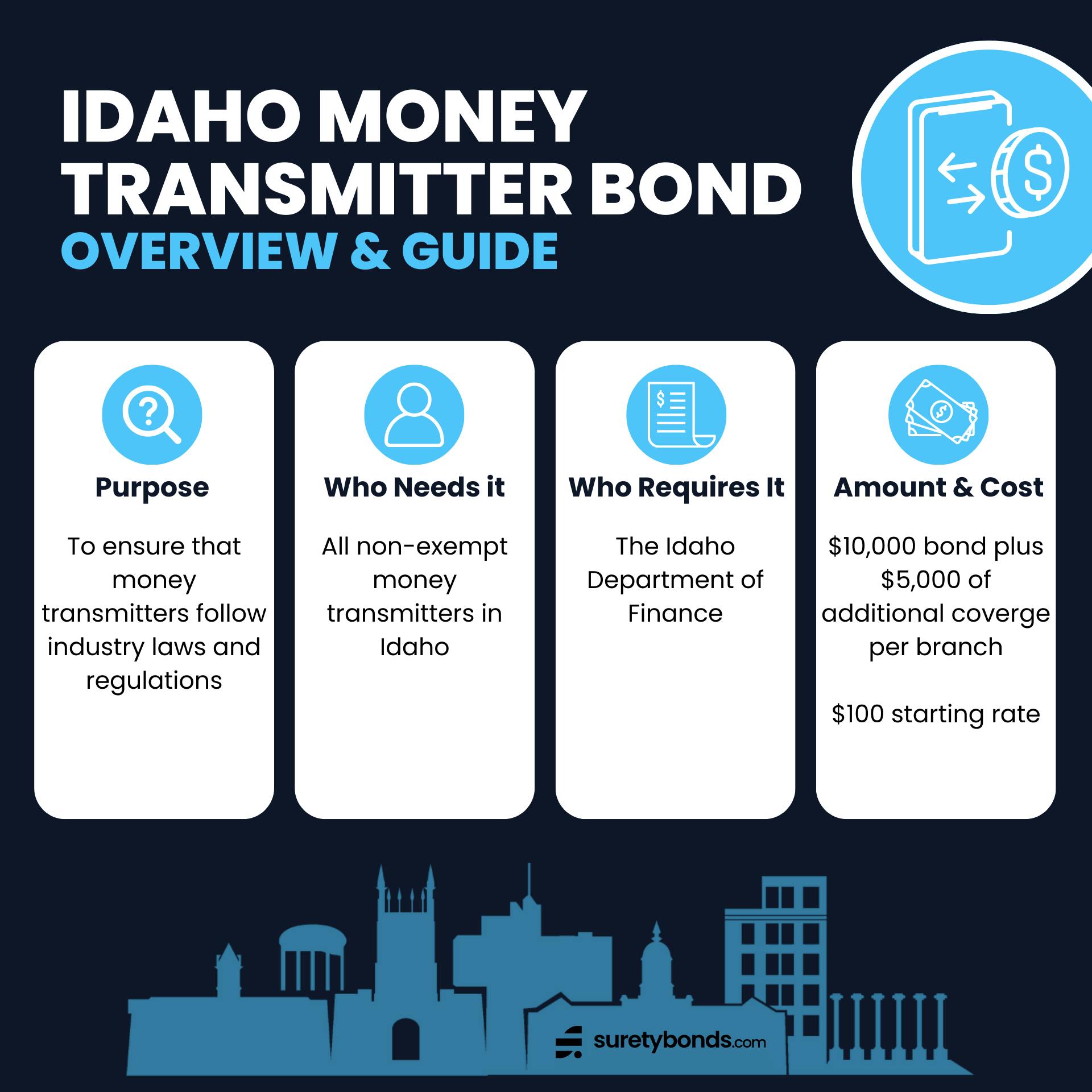
Idaho Money Transmitter Bond Overview
- Purpose: To ensure that money transmitters follow industry laws and regulations
- Who Needs It: All non-exempt money transmitters in Idaho
- Regulating Body: The Idaho Department of Finance
- Bond Amount: $10,000 + $5,000 per branch
- Minimum Price: $100
What Is an Idaho Money Transmitter Bond?
An Idaho money transmitter surety bond ensures that money transmitters adhere to industry laws and regulations.
Bonds are similar to insurance, but they protect consumers — rather than the business — by holding money transmission companies financially liable for their actions.
Who Needs a Money Transmitter Bond?
Any non-exempt person that engages in money transmission activities in Idaho needs a state license and $10,000 surety bond. This includes the following activities:
- Selling or issuing payment instruments
- Receiving money for transmission
- Engaging in money transmission by any means, such as payment instruments, wire, facsimile, or electronic transfers
If you’re applying to become an Idaho money transmitter for the first time, you’ll need a $10,000 surety bond. The bond coverage requirement increases by $5,000 per additional operating location or authorized representative, with a $500,000 cap.
| Bond Requirement | Number of Locations |
|---|---|
| $10,000 | Initial License |
| $15,000 | Original Location + 1 Branch |
| $20,000 | Original Location + 2 Branches |
| $30,000 | Original Location + 4 Branches |
How Much Do Money Transmitter Bonds Cost in Idaho?
Money transmitter bonds cost between 1% and 10% of the total coverage amount based on credit score. For example, $1,000 is the minimum price for a $10,000 Idaho money transmitter bond.
With excellent credit, you’ll likely receive a quote for $1,000, but you could pay more with a lower credit score. Submit a quote request today for your personalized rate.
SuretyBonds.com offers the lowest available rates from our nationwide provider network with no added fees.
How Does an Idaho Money Transmitter Bond Work?
Money transmitter bond forms are legal documents that bind three parties in a financial agreement.
| Bond Party | Description |
|---|---|
| 1) Principal | The money transmitter entity |
| 2) Obligee | The Idaho Department of Finance, Securities Division |
| 3) Surety | The issuing surety provider |
As the principal, you are responsible for upholding the bond terms, including as relevant state and federal legislation. If not, you are financially liable for claims made on the bond.
How Do I Get a Money Transmitter Bond in Idaho?
It only takes a couple of minutes to apply with SuretyBonds.com and get bonded within 1–2 days. Follow these steps:
- Complete the quote request form on this page
- Receive your personalized quote within one business day
- Checkout online at your convenience
That’s it! We’ll upload your official bond form to NMLS on your behalf. However, you’ll need to grant authority to your issuing surety provider. Log in to your NMLS account and enter the surety’s name or surety identifier (NAIC/NPN), which will be in your email records.
Can I Get Bonded With Bad Credit?
You may still be able to bond your money transmission business with poor credit. However, since these bonds are directly related to finances, poor credit may disqualify you.
Apply now to see if you qualify. Our surety experts will shop the top markets to find the best available rate for you. In some cases, you can provide additional financial documents to be approved with low credit.
How Do I Renew My Money Transmitter Bond?
These bonds expire annually. To renew, all you need to do is pay your renewal invoice when prompted.
If you added new locations and need to update the bond amount, contact SuretyBonds.com at 1(800) 308-4358 for assistance in increasing your coverage.
How to Get a Money Transmitter License in Idaho
The Idaho Department of Finance oversees money transmitter licensing, however, you’ll apply through the Nationwide Multistate Licensing System (NMLS).
- Prove net worth of at least $50,000 through financial statements
- Purchase a minimum $10,000 surety bond
- Provide information about any agents/locations
- Apply online through NMLS
Find more information in the resources linked below.